The Door to Yesterday
A Mr. Jingles adventure · Illustrated story
The North Pole had rules for everything. Where to stack the painted wooden trains, how long to cool gingerbread before it was ready to be decorated, and which bell meant the workshop was closing. There was even a special bell that meant Santa was coming.
But somehow, nobody had made a rule for the kitten born behind the toy store.
Mr. Jingles learned the North Pole from the ground up.
He learned the sharp hiss of snow along the alley bricks, the warm smell of sawdust that drifted through the loading bay, and the cheerful Christmas songs coming through windows he was never quite tall enough to reach.
He learned that elves made the presents.
He learned that Santa had a sleigh.
And he knew that the North Pole was full of doors that were supposed to stay locked.
Mr. Jingles had a talent for finding the ones that didn't.
If he pressed the strange candy cane he carried against a lock and listened carefully, sometimes—just sometimes—the lock would answer with a tiny, delicate chime.
He had no explanation for the cane. He had found it as a kitten, shortly after the day his mother disappeared.
He remembered that day in pieces.
The cold. The snow.
His mother's paws as she pushed him behind a crate, trying to hide him.
Then came the vehicle marked ANIMAL CONTROL that turned into the alley.
“Stay,” she had whispered. “Stay where they can't see you.”
He remembered her voice more clearly than anything.
Later, he heard her call his name. He almost moved. But her last instruction held him still, tucked into the darkness beneath the crate.
Then the van door slammed, and red taillights disappeared into falling snow.
He waited. And waited.
But she never came back.
No one ever told him where she went. When Mr. Jingles finally crawled out from beneath the crate, his whiskers were trembling.
The candy cane was lying beside him. It was unlike anything he'd ever seen. The red stripes never faded. Its little silver tip always felt warm, even on the coldest of nights.
Mr. Jingles carried the candy cane everywhere. He wasn't sure why, but whenever he carried it, he felt a little less alone.
And sometimes, when he pressed it against a locked door, he would hear a little click, a chime, a secret.
When he was small, Mr. Jingles tried every door in the neighborhood. Some opened, some didn't. He learned to listen, to wait, and sometimes to try again. The cane had its own ideas about timing.
One bakery door opened directly into an entire tray of cooling buns. This particular adventure ended with Mr. Jingles sporting a powdered-sugar mustache and pretending he had no idea where the missing buns had gone.
As he got older, he discovered a more useful talent: looking utterly innocent just after doing something suspicious. It was a skill that Mr. Jingles had gotten very, VERY good at.
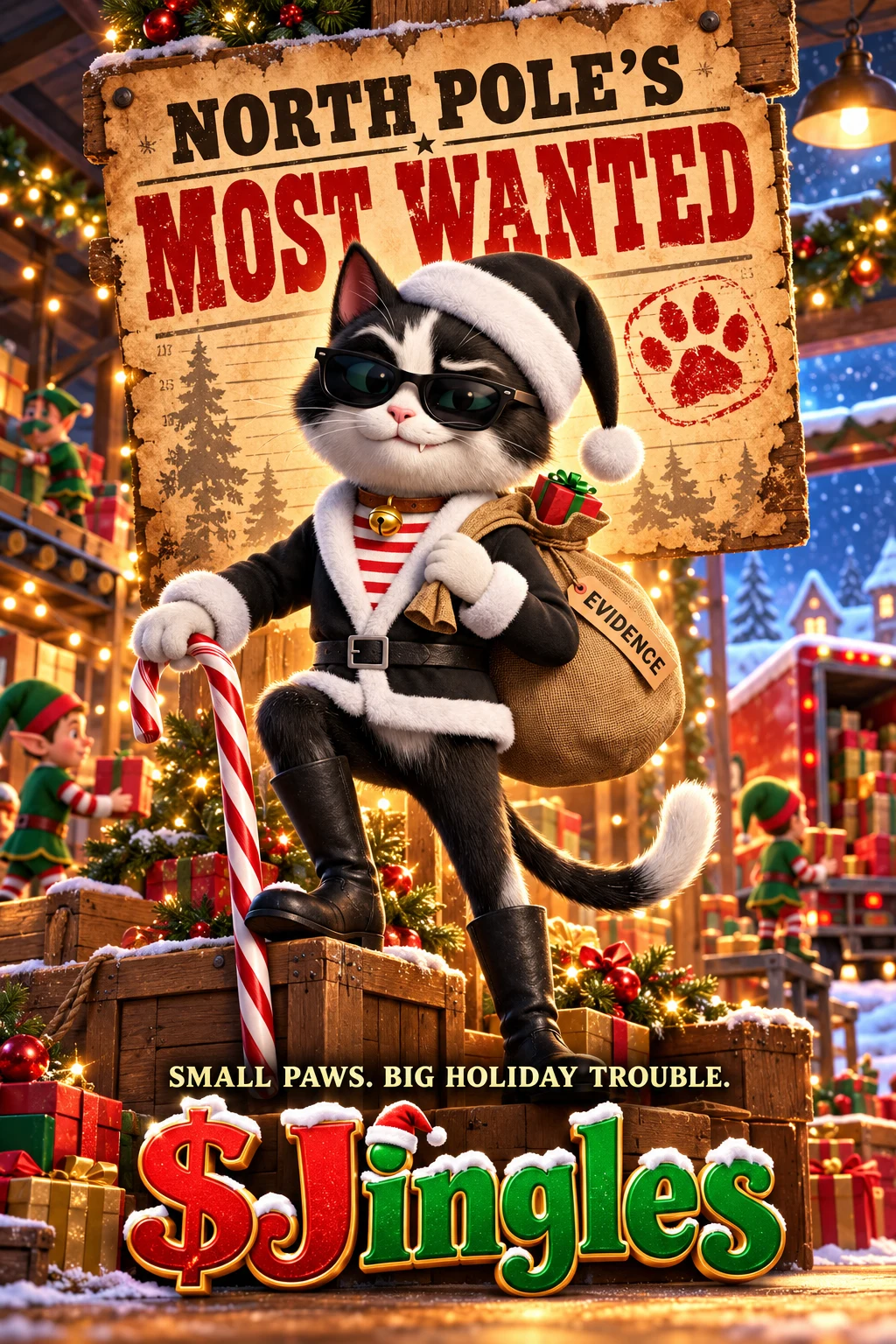
The stowaway
One evening a toy truck stopped behind the store. It was making its last run from the outlying settlement to Santa's central workshop district. Through the frosted glass, he watched elves load the last crates and sing so loudly they missed the small black-and-white shadow slipping between the wheels. An elf pulled the rear door almost closed. Jingles tapped the latch with his cane. It gave a soft ting. He climbed inside with a second to spare.
The truck carried him toward Santa's workshop, through a town of chimneys, bells, and windows glowing against the blue winter dark. Jingles peered out as the delivery rolled past rows of little houses. Some had wreaths; some had paper stars made by children.
At the bakery, the truck stopped to unload supplies. Jingles slipped down while the driver carried a flour sack inside. By the time the engine started again, he was beside the bakery window, following the warm smell that still lingered there.
The midnight cookie caper
A notice pinned to the glass read: COOKIE DAY CANCELED. Beneath it, a smaller line explained that the bakers were snowed in. An older poster promised 5,000 cookies for the children of the North Pole. Across the street, two children looked at the empty counter, then headed home with no treat and no fuss.
Jingles could never stand an empty plate that was supposed to be full.
That night he reached the bakery's service door. It was locked. He held the candy cane against it; there was the familiar bright ting, and the bolt slid back. He did not know why it worked. He only knew he had to be careful with it, because things worth getting into usually had someone on the other side.
Inside, flour exploded from a sack as soon as he touched it. Jingles emerged looking like a ghost in sunglasses. His first tray came out burned around the edges. He tasted one, winced, and set the whole batch aside. By the second tray he had the heat right. By the twelfth he had figured out how to swing the enormous mixing handle with his whole weight. The dough machine coughed, rattled, and finally joined him in a steady rhythm.
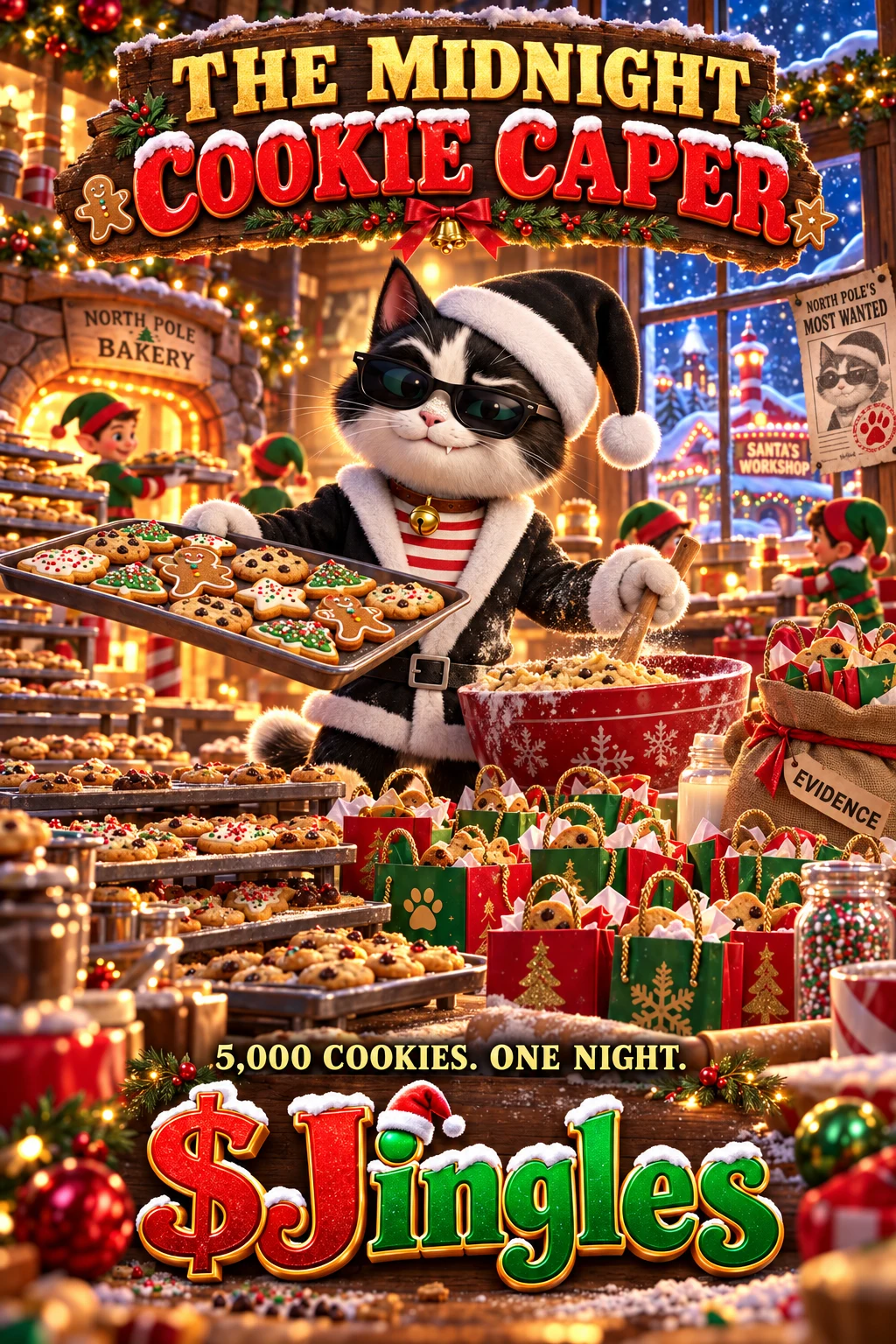
At dawn, exactly 5,000 cookies rested in red and green paper bags. The number was written in flour on the counter because Jingles had lost count twice and had to start again. He carried the bags on a borrowed handcart, leaving bags at doorsteps along the bakery's Cookie Day route. A small mittened hand opened the first door before he was out of sight. The child grinned. Jingles tucked his chin into his collar and pulled the cart a little faster.

A menace and a legend
By morning the bakery looked like a blizzard had moved indoors. Santa arrived with the North Pole police. A detective stared at the floury paw prints. Santa surveyed the empty butter shelves and the tower of dirty trays.
“This cat is a menace.”
Behind him, two elves saw the children outside comparing cookie shapes. One whispered, “He's a legend.” The other stifled a laugh behind a clipboard.
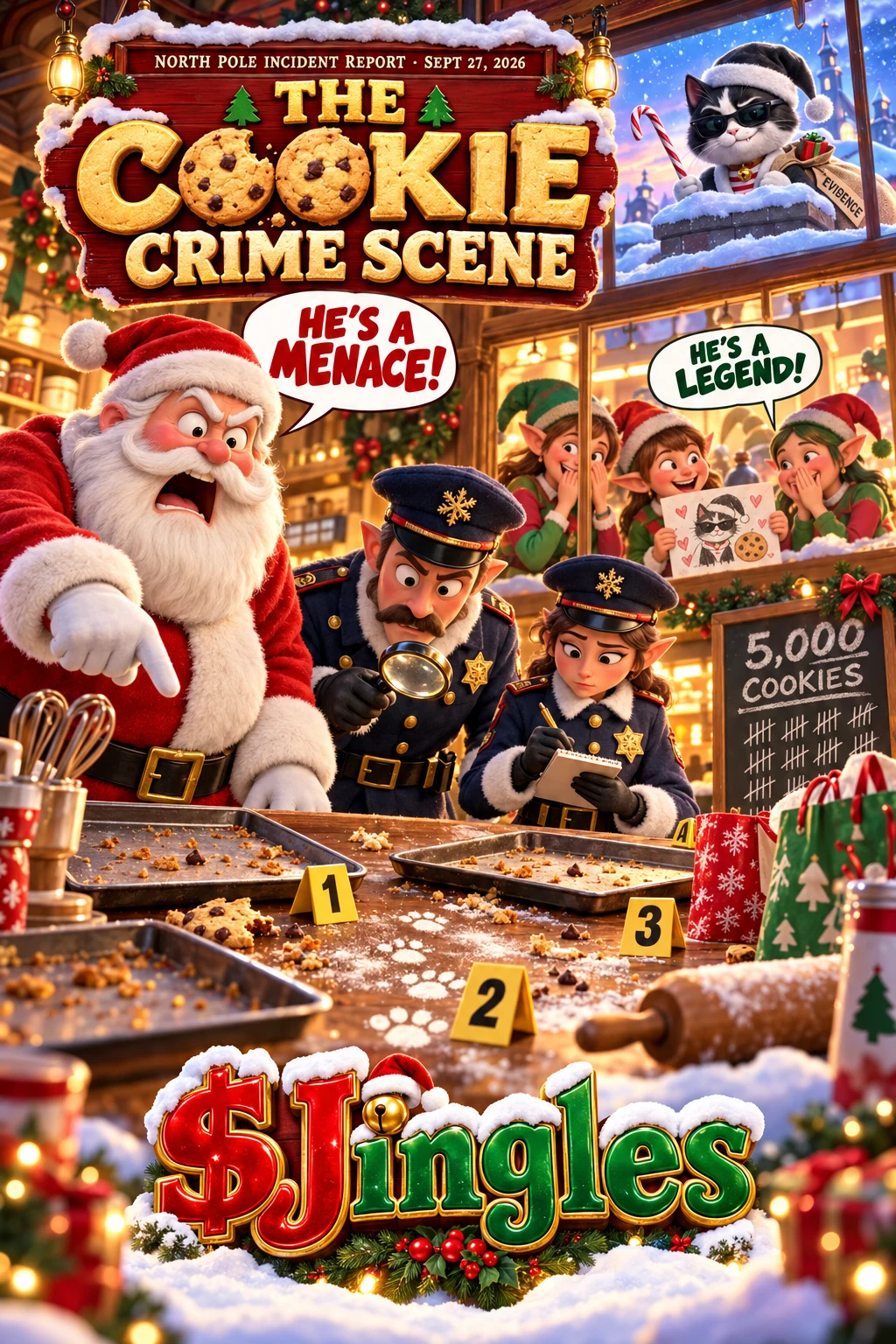
When the last bag was delivered, Jingles brought the empty handcart back to the bakery. He had meant to return it quietly. Through the window, he saw Santa, two police officers, and a detective bent over the counter.
He stopped, parked the cart beside the bakery's other carts, and straightened its handle with unnecessary care.
“Excellent,” he murmured. “Everybody's here.”
He slipped around the corner into the alley beside the toy factory. A wanted notice had already gone up there. Jingles saw his own face on it. He tipped his sunglasses down to compare the drawing to the real thing. The artist had made his whiskers look crooked.
“Rude,” he muttered.
The first meeting
Backing away from the notice, Jingles bumped gently into someone behind a stack of discarded boxes. Something clattered, and a little red wheel rolled into the snow.
“Sorry,” Jingles said. “Taking the scenic route.”
An elf was kneeling beside a broken toy train. One of the elf's ears stood upright; the other folded softly at the tip. A streak of white crossed his hair. His coat had been mended so many times that the patches looked like a map.
He was searching through a bin of rejected toys, patiently fitting bits of one train to another. A pair of workshop elves passed, glanced at him, and hurried on. The elf pretended not to notice.
Jingles spotted a small red wheel half buried under snow. He picked it up and held it out.
“Here you go.”
The elf looked up, startled, then took it. “Thank you.”
It fit perfectly. The little train rolled between them. The elf smiled as though someone had opened a window.
“They were going to throw it away,” the elf said, watching the train. “It was nearly all there. People just stopped looking.”
“That's their loss,” Jingles said.
The elf looked up again. This time his smile stayed.
“I'm Patch,” he said.
“Mr. Jingles. Unless you've seen the posters. Then I'm somebody else.”
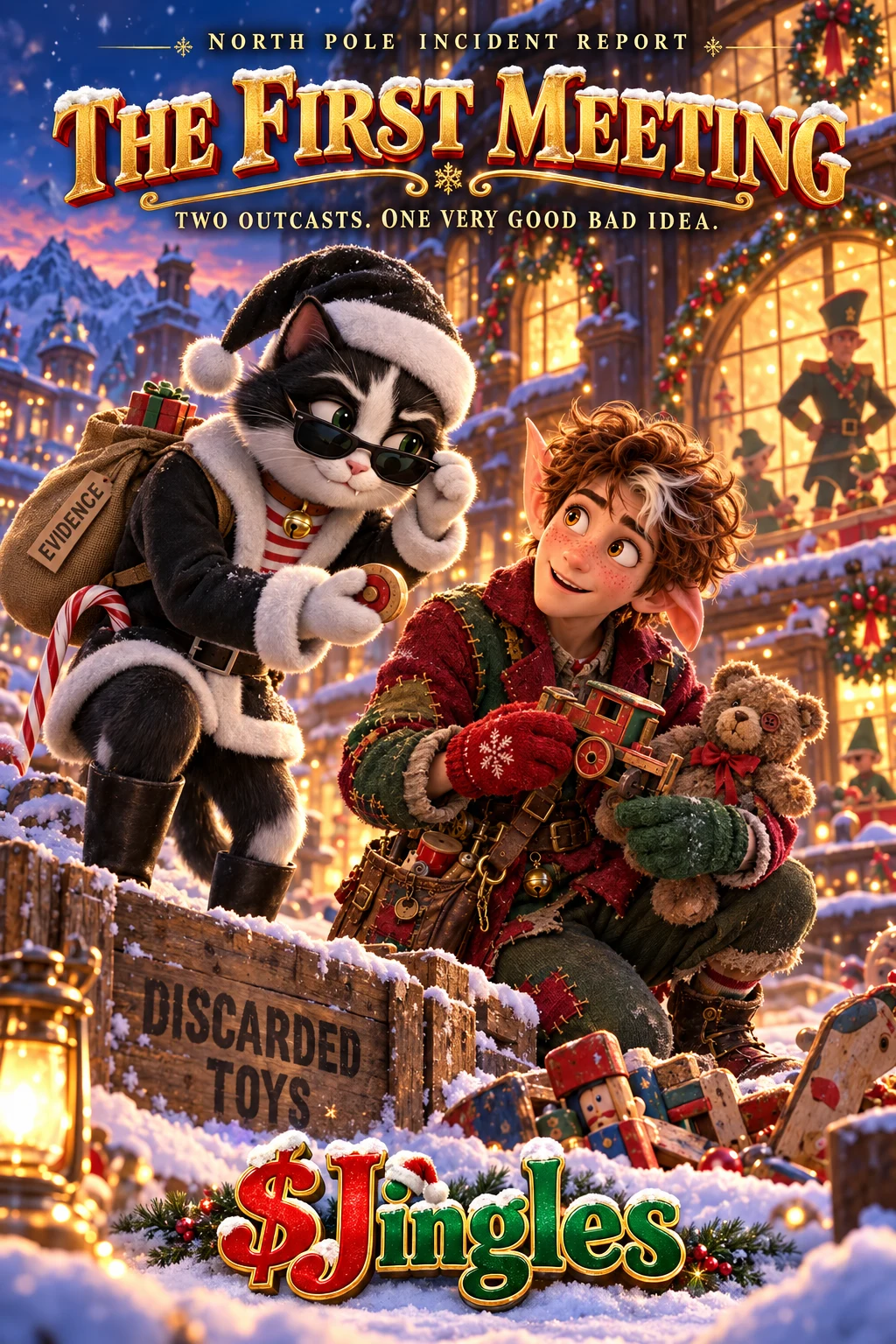
The police bell rang down the street. Patch glanced at the wanted notice, then at the cart tracks beside Jingles's boots. He understood more than he said.
“You should come with me,” Patch said. “There's a shorter way.”
They ducked through a side passage while two officers followed a set of floury footprints that belonged to a baker carrying supplies. Jingles couldn't resist saluting the officers from behind a snowbank. Patch caught his sleeve before he could make the salute too obvious. Both of them laughed, quietly and helplessly, until they reached Patch's apartment.
At Patch’s apartment
It was the most crowded little room Jingles had ever seen. Christmas drawings hung alongside sketches of circles, coils, cogs, and arrows pointing to dates. Halloween decoration boxes leaned by the door, waiting their turn in a town already obsessed with December. A vintage television showed a live news image about President Trump announcing plans for a new steel plant in Iowa. Patch turned the volume down. It was the sort of outside-world headline that made their snowy town feel suddenly attached to everywhere else.
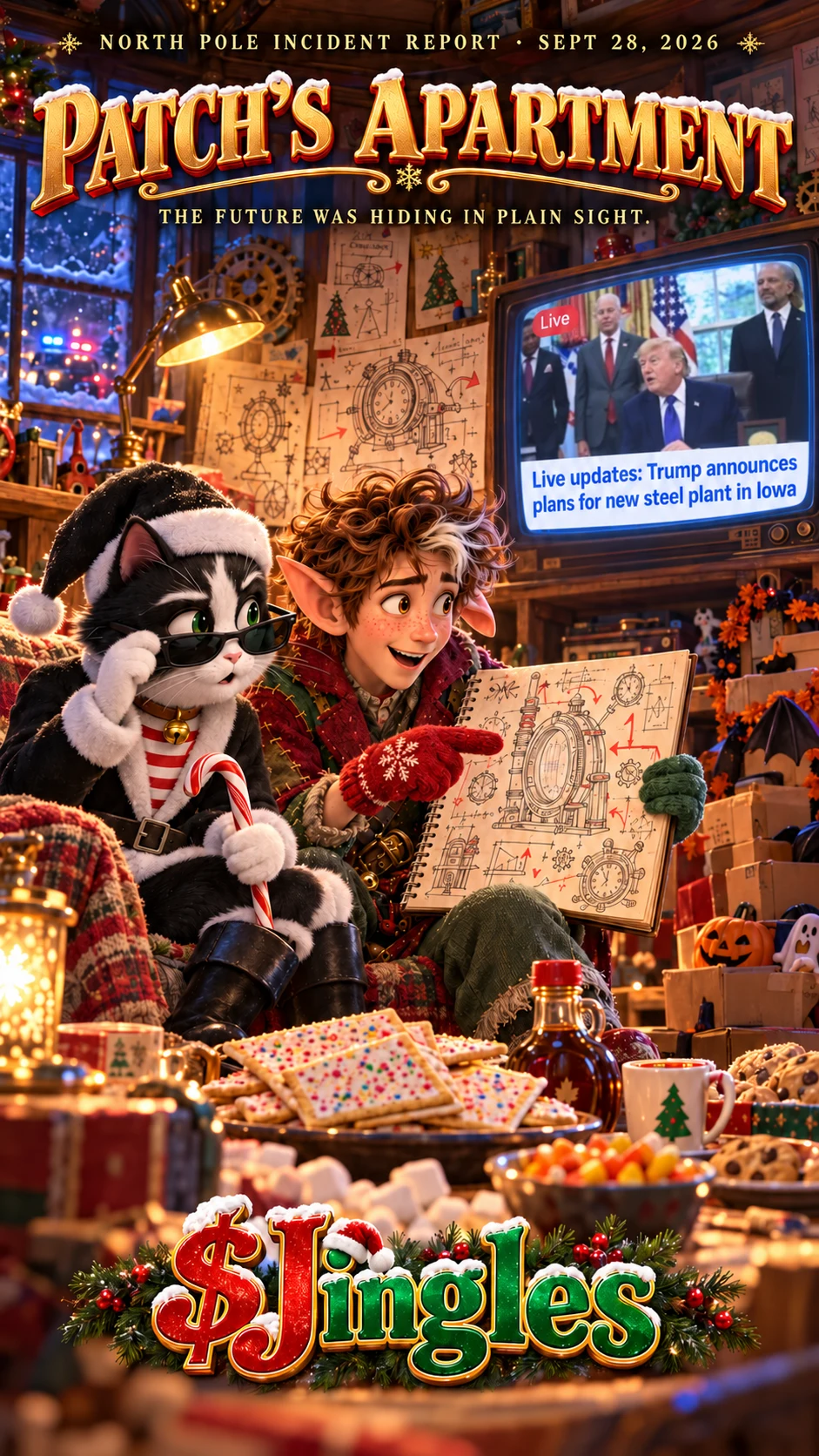
On the coffee table sat a plate of Pop-Tarts, marshmallows, candy corn, syrup, and cookies. Patch offered the whole thing. Jingles took one cookie. Patch stacked everything else onto his own plate.
“Us elves loves sugar!” he declared through a heroic mouthful.
“I can see that.” Jingles broke his cookie neatly in half and held up the pieces. “This is a balanced breakfast. I have one in each paw.”

A place we need to look
Patch laughed, then grew quiet as Jingles studied the drawings. A sketch showed a door surrounded by a ring of lights. A little handwritten note read: What if yesterday is a place?
“Why a time machine?” Jingles asked. He meant it lightly, but Patch's smile faded. “Oh, no. I'm not laughing at you. I'm curious. It seems I'm not the only one with a big dream.”
Patch sat on the floor beside the repaired train and spun its wheel once. He told Jingles how he'd been found alone when he was little. A North Pole foster family had taken him in and cared for him, but they couldn't tell him what had happened to his parents. Some elves had laughed at his different ear and his impossible ideas. Others were kind and still didn't understand why he kept collecting broken things.
“I thought if I could fix enough of them,” Patch said, “maybe I'd work out how to fix the part of my story that's missing.”
He had begun with clocks. Then engines. Then the idea that a journey could lead backward instead of north or south. He didn't want to change anyone else's life. He wanted to learn where his family went, and whether they had ever tried to find him.
Jingles didn't say I'm sorry. He remembered how empty those words had felt when he was small. Instead he rested his paw on the candy cane. For a moment, he was beneath the crate again, trying to obey a voice he could no longer hear.
“My mother disappeared too,” he said.
He told Patch the part he almost never told anyone: how long he'd waited, how he'd wondered whether coming out sooner might have changed something, and how he still watched that corner whenever he passed it. Patch didn't offer an easy answer. He stayed beside him.
Patch listened without interrupting. For a long time neither of them moved. The television flickered silently. Outside, a police whistle sounded and faded.
“Maybe,” Patch said at last, “we both have a place we need to look.”
Jingles picked up the repaired train and rolled it gently back to Patch. “Maybe we do.”
They spent the afternoon with the drawings spread across the floor. Patch explained the parts he had built, crossing out a mistake when Jingles noticed that one arrow pointed the wrong way. Jingles had no idea how the machine worked, but he was excellent at finding gaps. He kept asking what happened if a door wouldn't open. Patch kept answering, “That depends on the door.” By early evening the two had filled an entire page with questions.
The other room
When the light outside turned violet, Patch collected his papers. “Do you want to see it?”
“See what?”
Patch stood, walked to a door at the back of the apartment, and turned the handle. Blue light from beyond it drew a thin line across the floor.
Jingles sprang to his feet. “Are you serious?”
Patch opened the door wider and led him in. The machine filled most of the room: a tall circular frame, an enclosed platform, gears tucked behind glass, and careful handwritten labels on every panel. It was beautiful in the way a thing made out of patience can be beautiful. A small toy train sat on a shelf beside it, one of Patch's earliest repairs.

Jingles circled the platform. His boots squeaked on the polished floor. He removed his sunglasses to make sure he wasn't seeing a trick of the light.
“Does it work?” he asked, turning his head toward Patch.
Patch crossed to a breaker on the wall. “If my calculations are correct...” He threw the switch. “Yes. But no.”
Lights raced around the ring. A low hum filled the room; little brass indicators spun, and blue-white patterns moved across the ceiling. Jingles's eyes widened. He reached out, then thought better of touching anything. The machine sounded alive.

For a few seconds they stood in the glow without speaking. Jingles looked back at Patch.
“What do you mean, yes and no?”
“Everything here works,” Patch said. “It can power up, hold its field, run the calculations. But to jump through time, it needs a much bigger source. A nuclear fusion core.”
Jingles stared. “A what?”
“A nuclear fusion core!” Patch brightened at the familiar subject. “You know—like the one Santa uses to power his sleigh when he crosses the whole world in a night.” His excitement ebbed. “The only spare I know about is in the workshop vault. It's locked down tighter than anything in the North Pole.”
Jingles's gaze drifted to the moving lights. For one moment the blue reflections became snow in an older alley. He imagined arriving before the animal-control vehicle, hearing his mother's voice again, and finding a way to keep her with him. He didn't know if any of that could happen. Wanting it was enough to make his chest ache.
Patch had gone still too. In the glass, he saw a younger version of himself waiting at a doorway, looking up whenever footsteps passed. He imagined finding his parents and finally asking the question he'd carried since childhood: What happened?
The machine hummed. Neither friend spoke. Then Jingles blinked, tucked his sunglasses back into place, and looked at Patch with a grin that was almost as much courage as confidence.
“You are in luck, my new friend.” He lifted his candy cane. “See this? It has powers. I can get through any lock.”
Patch raised an eyebrow. “Any lock?”
Jingles glanced at the warm silver tip. He remembered doors that had needed a second try, and a few that had refused him altogether.
“Well,” he said, “I haven't met this one yet.”
Patch laughed. Jingles's grin softened.
“But I'll try,” he added. “And you won't have to try alone.”
Patch looked from the cane to the machine, then toward the distant workshop visible through the high window. Somewhere outside, Santa's sleigh bells rang for the evening inspection.
The two friends faced the glowing ring together. On the other side of a locked door was a chance to ask yesterday a question. For the first time, neither of them would have to ask it alone.
End of Episode One.